What is body doubling? How working beside someone helps you start

Body doubling means doing your own work while someone else does theirs nearby. Here's what it is, why it helps you start, and three easy ways to try it.

That one work task has been open in a tab since Monday. Then your housemate sits down at the kitchen table to do their own work, and twenty minutes later it's done.
That's body doubling. It's one of the simplest ways to get going on work you've been putting off, and you can try it today without buying anything.
I'm Skye, and I found body doubling in 2021. The coworking space I was paying hundreds of dollars for didn't have the subtle commotion and friendly energy I needed to spark focus. Online body doubling did, at a fraction of the cost: most tools run between $15 and $40 a month. It paid me back many times over, and I stopped losing time and money to the drive there and back.
What is body doubling?
Body doubling means doing your own work while another person does theirs, in the same room or on the same call. The other person is your "body double". They don't help with your task, check your progress or coach you. They're just there, working on something of their own.
Nobody is in charge of anybody. You're two people, or ten, who agreed to work at the same time.
You'll hear the term most often in ADHD communities, where people share it as a practical way to get started. But you don't need a diagnosis to try it, and people in every line of work do: lawyers, producers, designers, writers on a deadline, students before exams and freelancers who work alone all week.
Research: The first academic study of body doubling surveyed 220 people who use it. Most said they'd been doing it long before they learned it had a name, for everything from studying to dishes to exercise, to build momentum and stay on task. Source: Eagle, Baltaxe-Admony and Ringland, ACM ASSETS (2023)
Why does working next to someone help?
There's no magic in it. A few ordinary things change when someone else is working too.
- There's a start time. "I'll do it later" is easy to say to yourself. It's harder when someone is sitting down at ten and you said you'd be there.
- You name the task. Saying "I'm sending the invoice" out loud, even to one person, turns a vague worry into one small thing to do.
- The room has a rhythm. When everyone around you is quietly working, working is simply what's happening. Opening a new tab feels a little out of place.
- There's an end. A session that finishes at a set time makes the work feel finite. You only have to stay with it until then.
None of this needs the other person to watch you. Most body doubles barely notice what you're doing. The point is company, not supervision.
Is body doubling only for ADHD?
No. Anyone can try it, and the reasons above apply to most kinds of focused work. It isn't a treatment for anything, and it doesn't replace support from a doctor or therapist if you need it. Think of it as a working habit, like studying in a library or writing in a café. Some people find it helps a lot, some a little, and the only way to know is to try.
It's a good fit for work you know how to do but keep putting off: email, admin, a first draft, studying for an exam, the forms you've been avoiding. If you're learning something brand new and need deep quiet, a solo block may suit you better that day.
Research: Psychologists have studied this for more than a century, since Norman Triplett noticed in 1898 that children winding fishing reels went faster with another child beside them. A review of 241 studies found that having other people around tends to help with simple or well-practiced tasks, and can make complex, unfamiliar ones harder. Source: Bond and Titus, Psychological Bulletin (1983)
What people body double for
Pretty much anything you can do while someone else does their thing. I've hosted rooms where people put in more than 45,000 hours of focused work, and here's some of what I've seen get done:
- Laundry. The pile on the chair counts. So do the dishes.
- Art. Professional artists in their studios, working on pieces bigger than they are.
- Practice. Musicians putting in a set stretch of time on their instrument.
- Legal work. Lawyers drafting legal documents.
- The whole workload. Executive assistants working through everything on their plate.
- Awards season. A Hollywood producer running an Oscars campaign.
- Content. Creators planning and making their content, and growing their businesses to six figures.
If it's on your list and you keep putting it off, it's a good candidate.
How to try body doubling
There are three common ways, and you can try all three in a week.
In person
Ask a friend, partner, housemate or colleague to work alongside you for an hour. Sit at the same table or in the same room. Tell each other what you're working on, set a timer and stay quiet until it goes off. Libraries and cafés give you a lighter version of the same thing: strangers working nearby.
On a video call
You don't need to be in the same place. Call a friend, say what you're each working on, then mute and keep your cameras on, or off if that's more comfortable. When the timer ends, unmute and say how it went. This is the easiest way to make body doubling a weekly habit with someone who lives far away.
Research: In Buffer's 2023 survey of 3,000 remote workers, 23% named loneliness as one of their biggest struggles. Source: Buffer, State of Remote Work (2023)

In an app or online session
If nobody you know is free when you are, join a scheduled online session. You book a time, show up, say what you're working on and work alongside whoever else is there. A good session gives you a clear start, quiet focus time and a short wrap-up, with a host keeping time so you don't have to.
Tips for a session that works
- Pick one task, and make it small. "Write the intro" beats "work on the report".
- Say it out loud or write it down. Naming the task is half of what makes this work.
- Use a timer. Fifty minutes is a common block. For a longer stretch, take a short break between blocks rather than going three hours straight.
- Check out at the end. Say what you got done. Half done counts.
- Make it a standing time. The same time with the same people each week is what turns one good session into a habit.
How body doubling works on Crews
Crews is a virtual coworking app built around body doubling sessions you join from your browser. Members host sessions on a shared schedule, and you book a spot in the one that fits your day.
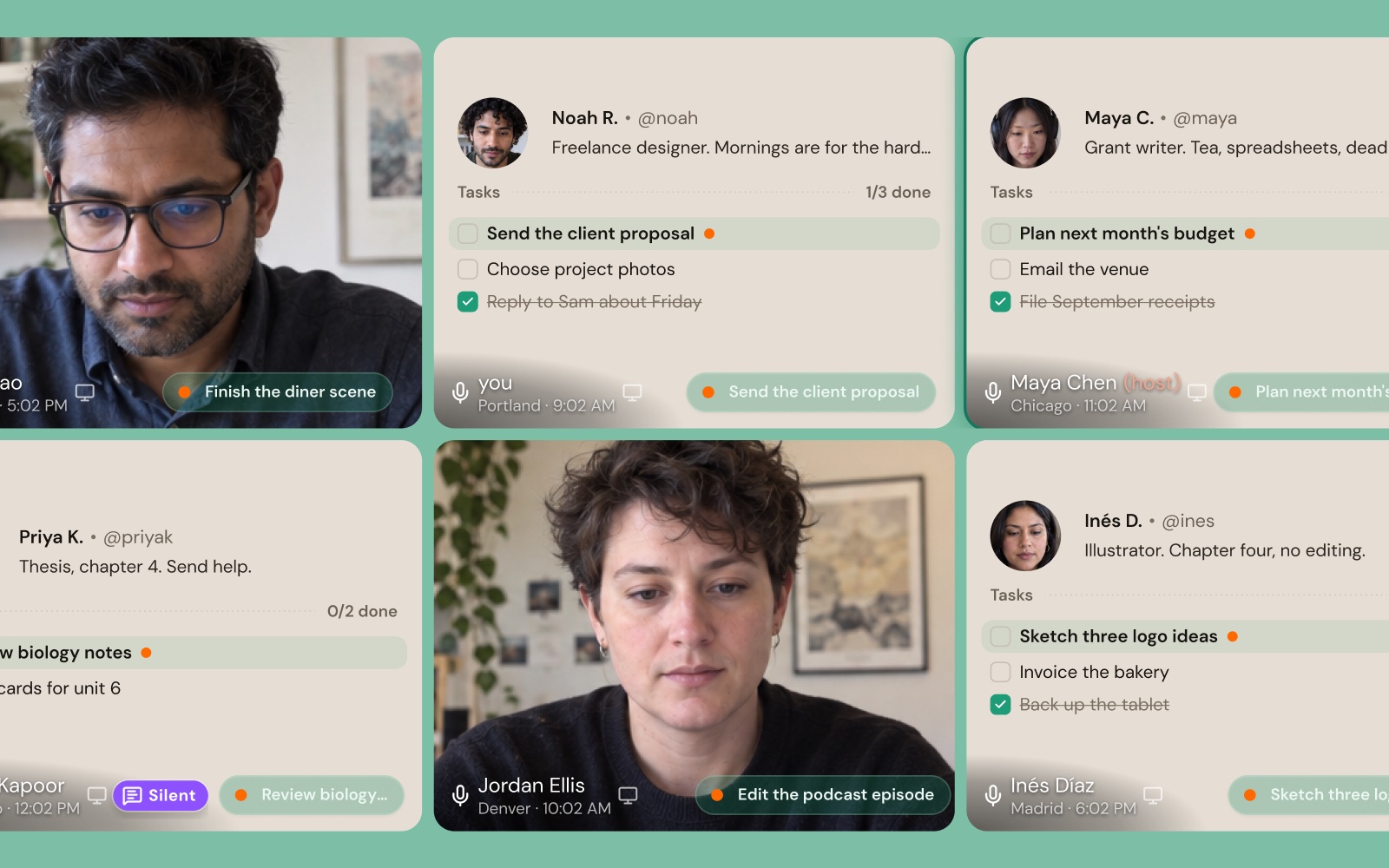
The room opens 15 minutes before the start. You check your camera and mic in the lobby, then enter. Every session follows the same shape:
- Check-in. Everyone says hi and what they're working on. In verbal sessions you say it out loud; in chat-only sessions you type it.
- Focus. Heads down, mics off until the next check-in.
- Breaks. Longer sessions are split into focus blocks with short breaks between them. Stretch, grab water, chat if you like.
- Debrief. Mics open again to share how it went.
The goals you set at check-in show to the people in the room while the session runs, so everyone can see what everyone else is working on. When the session closes, your goals are yours alone again, and anything you didn't finish is saved to your private tasks so it's waiting next time.
You don't have to talk. Camera and mic are always your choice, and in a verbal session you can switch on Silent mode to check in by chat instead. If the verbal seats are full, or you're running late, you can join as an observer if a seat is open: no mic, same room. The first-session guide covers what happens if you're late.
When you find people you like working with, you can form a crew together: a group with its own chat that stays open between sessions.
FAQ
What's the difference between body doubling and coworking?
They overlap. Coworking usually means sharing a workspace, in person or online. Body doubling is about the effect of working next to someone, and it can happen anywhere: at a kitchen table, on a video call or in a coworking session. A virtual coworking session with a check-in and a shared start time is a body doubling session with a schedule.
Do I need to be on camera?
Not for body doubling in general, and not on Crews. Some people like seeing others work; others are happy just knowing they're there. On Crews, camera and mic are always your choice.
How long should a body doubling session be?
Start with an hour or less. That's long enough for one good focus block and short enough to say yes to. On Crews, sessions run from half an hour up to three hours, and the longer ones include breaks.
Can I body double with a friend?
Yes. Book the same session, or start a crew together so you have a shared chat and a place to plan your next session.
Try your first session
Pick one small task, book a spot and say it out loud at check-in. Try Crews free for 7 days and find a session that fits your day.
Get it done with people in the room
Pick a session, say what you're working on, and start. Other people are working too, and that's usually enough to keep you going.
Join a session free